Green voters hunting for green reps

by Gan Pei Ling / 22 August 2011 © The Nut Graph

green-votersRUMOURS have been rife since late 2010 that Prime Minister Datuk Seri Najib Razak might call for the 13th general election by this year before the economy takes a worse turn. As such, not just political parties but civil society has been gearing up for an impending election.

Among the civil society groups are a group of environmentalists, who set up Green Voters in July 2011 to mainstream and highlight environmental issues at the upcoming elections. The collective has yet to finalise its action plan but the idea is to focus candidates and political parties’ attention on environmental issues.

It would be amazing if all contesting candidates in the next general election were posed key questions on the environment in their respective constituencies à la The Nut Graph’s MP Watch project.

It is difficult to narrow down the key environmental questions, considering the many environmental issues Malaysia needs to tackle, but here are the questions I would ask candidates standing in my constituency:

1. What’s your stand on nuclear power? Do you agree or disagree that Malaysia needs to go nuclear? Why?

Reactor Unit 3 (right) and Reactor Unit 4 (left) of the Fukushima I Nuclear Power Plant (source: Wiki Commons)

Reactor Unit 3 (right) and Reactor Unit 4 (left) of the Fukushima I Nuclear Power Plant (source: Wiki Commons)

The federal government’s 2010 announcement to build two nuclear power plants in Malaysia by 2021 has received mixed public reactions. The Fukushimameltdown in March 2011 has caused a further negative dip in public perception towards nuclear power.

Germany plans to shut down its nuclear reactor by 2022 but China is going ahead with its plan to build 36 reactors within the decade while our Prime Minister Datuk Seri Najib Razak said nuclear remains an “option” for Malaysia.

Regardless whether a candidate supports or objects to nuclear power, I’m more interested in the reasons for their stand.

2. Would you support an amendment to make public consultation compulsory before a forest reserve can be de-gazetted? Why?

Currently, forests, including those that have been gazetted as reserves can be cleared in the name of development for, say, highway construction without public inquiry except in one state. Selangor made history in April 2011 when it passed an amendment to the state’s Forestry Act to ensure a public inquiry must be held before a forest reserve can be excised. However, other states have yet to emulate Selangor’s move.

Our elected representatives should understand that sustainable development is crucial if we want to ensure tragedies such as the 21 May 2011 Hulu Langat landslide, 2008 Bukit Antarabangsa landslide and 1993 Highland Towers collapse do not recur. We need to protect ecologically-sensitive areas not just for conservation purposes but also for our own sake.

Damage caused by the Bukit Antarabangsa landslide of 6 Dec 2008 (Pic courtesy of Raj Kumar)

A properly implemented public consultation process would not only serve to promote transparency and accountability but also encourage participatory democracy among our citizens.

3. Would you support tax rebates for developers and property owners that incorporate eco-friendly designs such as rainwater harvesting systems and solar panels? Why?

This question was inspired by the Petaling Jaya City Council’s initiative to introduce a tax rebate scheme for “green” houses in the city, which is expected to be finalised by the city council by the end of 2011.

The tax rebate scheme would also complement the federal government’s feed-in-tariff system which would allow individuals to sell electricity produced from renewable energy back to Tenaga Nasional Berhad.

4. Would you work with the local council(s) to promote recycling and set up more recycling centres in your constituency?

Ideally, such initiatives should be done by local councillors but local government elections have yet to be restored. So it would not be too much to ask of our Member of Parliament and state assemblyperson to work with the appointed local councillors in their constituencies to promote recycling, would it?

There are other important questions that are more localised. For example, if I were a voter in Pahang, I would ask the contesting candidates on their stand on the Lynas rare earth refinery. If I were a voter in Sarawak, I would ask the candidates whether all the dams the state is constructing are really necessary.

For too long election issues have been determined by politicians and political parties, often centred on race, ethnicity and religion. If elections were to truly reflect the people’s will, then the rakyat needs to take the initiative to determine the agenda of an election instead of allowing politicians to steer public discourse along populist and often divisive and unhelpful lines.


Disclosure: Gan Pei Ling was invited by forest conservationist Lim Teck Wyn to join Green Voters but has remained mostly a dormant member. Still, she is always inspired by citizens’ initiative to reclaim democratic processes, especially the elections, and thinks it’s definitely worth highlighting.

Wanted: Safe and eco-friendly cosmetics

by Gan Pei Ling / 25 July 2011 © The Nut Graph

BODY wash, hair shampoo, soap, facial cleanser, toner — most of us use these personal care products on a daily basis regardless of gender. Women are likely to use cosmetics as well in addition to these products, but have you ever stopped and looked at the ingredients contained in the products? The ingredients should be safe, right?

Not necessarily. It turns out that the multi-billion cosmetics industry might not always have consumers’ best interests at heart

Published in 2007, Not Just a Pretty Face: The Ugly Side of the Beauty Industry exposed the pervasive use of toxic chemicals in personal care products. Written by former journalist Stacy Malkan, the book also exposed hypocritical cosmetics companies that brand themselves as pink ribbon leaders, yet continue to use hormone-disrupting chemicals or potential carcinogens in their products. The author is now one of the leading advocates for the Campaign for Safe Cosmetics in the US.

Another short film, The Story of Cosmetics, was released in 2010 to raise public awareness and rally support for the campaign. Although both the book and film were based on an American context, I think they are equally relevant to Malaysian consumers. Similar harmful products are being imported and sold in local stores, yet most of us remain ignorant of this.

So what are the ingredients that we should stay away from when shopping for personal care products? Are all products labelled “organic” or “natural” safe? And what are some of the local alternatives available to Malaysians?

Ingredients to avoid

“Cosmetics should be safe enough to eat,” Horst Rechelbacher, founder of one of the largest eco-friendly beauty salons Aveda, once told The New York Times in 1997. He was right, if you can’t eat it, why would you want to apply the ingredients on your body as the skin would absorb the ingredients and they would end up in your body anyway?

To help consumers search for safe cosmetics and personal care products, one of the key partners in the Campaign for Safe Cosmetics – the Environmental Working Group (EWG) — has set up a cosmetics database called Skin Deep in 2004Below is a list of ingredients to avoid in various personal care products compiled using resources from the database:

  • Soap
    • Bar soap — Triclocarban
    • Liquid soap — Triclosan
    • Toothpaste — Triclosan

Reason: Triclocarban and triclosan are chemicals used to kill off microorganisms such as bacteria and are toxic to aquatic environments.

  • Day-time moisturiser — Retinyl palmitate and retinol (Vitamin A)
  • Lip balm — Retinyl palmitate and retinol
  • Sunscreen — Retinyl palmitate and retinol, oxybenzone

Reason: Vitamin A is a nutrient but it may cause birth defects if pregnant women are exposed to excessive amounts of it. Oxybenzone is a common sunscreen agent that has been linked to hormone disruption.

  • Hair products – Fragrance, PEGs, ceteareths, polyethylene, parabens and DMDM hydantoin

Reason: Hundreds of chemicals can be included in the term “fragrance” while PEGs, ceteareths and polyethylene compounds are synthetic chemicals frequently contaminated with potential carcinogen 1,4-dioxaneParabens are commonly used as preservatives. Usually listed as methylparaben, ethylparaben, propylparaben etc, these chemicals may disrupt the endocrine system. DMDM hydantoin is another preservative. It releases the carcinogen formaldehydewhen it decomposes.

  • Nail products – Formaldehyde, toluene and phthalates

Reason: Formaldehyde is a carcinogen while toluene is a potent neurotoxin. Phthalates are a group of industrial chemicals that may disrupt our hormone and reproductive systems.

Having trouble memorising all the chemical terms? So did I when I first researched this subject. But it also made me wonder what all these chemicals were doing in personal care products, some of which we use on a daily basis.

It was not pleasant to discover methylparaben and ethylparaben as listed ingredients in my facial cleanser and body wash, so I went on a quest to look for paraben-free and safer products.

Local handmade personal care products

I stumbled upon two female entrepreneurs who make their own skincare products at a flea market at Jaya One, Petaling Jaya last month.

Shelby Kho, 30, is a doctor who makes bath scrubs, bath salts and other body products as her passion. She learned to make them during college and used to make these body products as gifts for her friends. It did not occur to her to sell the products at flea markets to a larger audience until December 2010.

She does not use any artificial fragrance, preservatives or colourings in her products. Natural ingredients such as manuka honey are used as preservatives and essential oils as fragrance.

Bisou Bon Bon (pic courtesy of Gan Pei Ling)

Kho calls her line of products Bisou Bonbon (which means “candy” in French). Best of all, her products are reasonably priced, ranging from RM9 for a lip balm to RM28 for a jar of body scrub.

RM40 trial set of a 3-in-1 facial cleansing powder, scrub and mask and a 2-in-1 toner and moisturiser.

Meanwhile, Sal, also 30, is a homemaker from Petaling Jaya. She started making her own facial products when she began to develop sensitive skin at the age of 25 and the condition did not improve after she tried different commercial brands.

After experimenting with various recipes, Sal developed her own skincare line called Back to Basicswhich includes cleanser, toner-cum-moisturiser, treatment powder and face serum. Similar to Kho’s body products, Sal does not use chemicals in her products.

“Sometimes I’ll modify my products to suit the customers’ needs as some of them have more sensitive skin,” she said when met at the flea market in June.

Apart from these handmade products, Malaysians may also find safer and biodegradable commercial products at The Body Shop and TNS Skin Lab but their products may of course be pricier.


Gan Pei Ling is still searching for safe and eco-friendly personal care products, especially local handmade ones. Drop her a line at editor@thenutgraph.com if you know of any.

“Saya bukan Melayu, saya Orang Asli”

by Gan Pei Ling / 2 May 2011 © The Nut Graph

(All pics below courtesy of Tijah Yok Chopil)

ONCE, when she attended a job interview in the Klang Valley, Tijah Yok Chopil’s Malaysian employer did not get it when she told him she was an Orang Asli.

“Dia ingat saya orang Indonesia atau Melayu … Saya beritahunya [selalu kita cakap] Melayu, Cina, India dan lain-lain, saya [sebahagian daripada] dan lain-lain … Apabila saya beritahunya ada 18 suku kaum Orang Asli di Semenanjung, dia lagi pening,” Tijah recalled.

The activist said it goes to show how ignorant some Malaysians could be about the indigenous people in Malaysia.

Tijah started her activism by founding her own women’s group in her kampung in Bidor, Perak called Kumpulan Ibu-Ibu Kampung Chang. From there, the group evolved into Sinui Pai, Nanek Sengik (New Life, One Heart) in 1995. They ran programmes to empower the community with economic skills and knowledge about their rights.

Over the years, the model spread to other villages in Perak and other states, eventually resulting in the formation of Jaringan Kampung Orang Asli Semenanjung Malaysia (JKOAS). The grassroots network has been highlighting Orang Asli issues and campaigning for the government’s recognition of their land and indigenous rights.

Tijah, who is now JKOAS secretary, shares her humble beginnings and some Orang Asli folk tales with The Nut Graph in an interview on 23 Oct 2010 in Petaling Jaya.

TNG: Bila dan di mana Tijah dilahirkan?

Saya berasal dari Kampung Chang Lama Sungai Gepai di Bidor, Perak dan dilahirkan pada 17 March 1968 – sama tarikh dengan demonstrasi Orang Asli tahun lepas di Putrajaya.

Boleh kongsi asal-usul keturunan Tijah?

Saya tulen berketurunan Semai.

Mengikut kepercayaan nenek moyang saya, komuniti Semai sudah wujud di sini semenjak batu-batu masih lembut. Buktinya tapak-tapak kaki yang masih kekal di atas batu dekat kawasan air terjun kami.

Footsteps made by her ancestors when the rocks were still young, according to Tijah’s village folk tales

Ceritanya, [pada masa dahulu], ada dua orang adik perempuan yang dikejar hantu rusa. Kami memanggil dua orang gadis itu ubai baleh dalam bahasa Semai. Rusa itu sepatutnya dimakan tetapi tertangguh-tangguh selama tujuh hari sehingga terjemar menjadi hantu dan mengejar dua budak perempuan itu semasa ibu bapa mereka pergi ke hutan. Tapak kaki dua orang adik-beradik dan hantu rusa masih ada di kawasan air terjun sampai sekarang.

Ramai orang pernah tanya saya sejak bila Orang Asli wujud di tanah Semenanjung, kami tidak pasti jangka masa [yang tepat], tetapi kami tahu kami memang orang asal tanah ini, tidak ada keturunan dari negara-negara lain macam orang lain.

Selain daripada cerita tadi, apa cerita Orang Asli lain yang sering diberitahu orang tua yang Tijah gemar?

Ada banyak cerita. Menurut kepercayaan kampung saya, pada sesuatu ketika, tanah Semenanjung ini berada dalam keadaan yang gelap sebab bulan telah terjatuh ke bumi. Saya pernah mendengar cerita yang sama di kampung-kampung lain, mungkin keadaan ini berlaku sedunia.

Maka salah seorang nenek moyang kami yang halak (mempunyai ilmu spiritual yang tinggi) telah mengadakan sewang bubun gelap selama 14 malam, 14 siang untuk memujuk semangat bulan kembali ke langit. Ini kerana mereka mempercayai semakin lama [bulan] tinggal di bumi, dia akan makan manusia.

Nenek moyang yang halak itu kami memanggilnya Tok Churoq. Dia telah berjaya menghantar bulan balik ke langit. Maka bulan pun ingin membalas budinya dan memanggilnya untuk menyediakan tujuh lapis tikar krawoq, sejenis tikar mengkuang dengan anyaman khas yang sangat cantik.

Namun Tok Churoq tidak sempat menyiapkan tikar itu dan tuhaad (hadiah mengenang budi) itu terus menembusi bumi. Bulan memberitahunya batu itu sebenarnya batu umur, sesiapa yang uzur bersandar dekat batu itu akan menjadi muda lagi. Tetapi sekarang batu itu sudah jatuh ke dasar bumi, maka ditakdirkan umat manusia di dunia ini akan mati di atas bumi dan dihidupkan kembali apabila dikebumikan. Kepercayaan ini masih dikekal di kalangan kami.

Saya tahu cerita ini macam cerita dongeng, tetapi kami mempercayai dan menurunkan cerita-cerita ini dengan jelas kepada anak-anak kami.

Ada lagi cerita tentang asal-usul kejadian pokok, ikan, binatang dan sebagainya, saya suka mengambil cerita-cerita ini tetapi tidak ada masa untuk mencatat dalam buku betul-betul.

Apakah kenangan Tijah yang paling kuat semasa membesar?

Ibu bapa saya sangat baik hati, kami bukan orang senang, memang orang susah, tetapi mereka akan berkongsi apa yang ada dengan orang kampung. Kami tidak pernah makan bersendirian, mesti ada tetamu. Kadang-kadang kami berasa sedih kerana kami sendiri pun tak cukup makan.

With 100 other Orang Asli representatives attending a convention in Kuala Lumpur in December 2010

Bapa saya meninggal dunia ketika saya 12 tahun, keadaan menjadi lebih susah, emak saya terpaksa pergi menoreh getah, memancing ikan dan mencari ubi keledek, ubi keladi atau ubi kayu walaupun sakit tulang. Emak masih akan berkongsi makanan kami dengan orang lain pada ketika itu kerana dia memang tidak sampai hati orang lain melihat sewaktu kami makan.

Walaupun hanya 12 tahun, saya macam sudah dewasa kerana terpaksa membantu emak dan kakak, bersama-sama pergi menoreh getah kami seluas dua ekar. Pokoknya tidak banyak kerana sudah tua dan mati dimakan anai-anai.  Saya dan kakak juga bekerja di kebun sayur orang Cina, kami berjalan kaki sejauh tiga hingga empat batu tiap-tiap hari.  Kami tidak bermain-main seperti kanak-kanak lain, bekerja itu menjadi sejenis permainan bagi kami.

Sungguhpun saya seorang perempuan, saya pernah membuat pelbagai kerja macam anak lelaki – membacu simen, membuat pagar, memotong kayu sepanjang lapan kaki, sebesar ibu jari kaki dan diikat sebanyak 25 kelamin, selepas itu mengangkutnya ke suatu tempat yang diperlukan dengan memikul dibahu. Kerja ini kami lakukan sebelah petang selepas kembali dari kerja di kebun-kebun sayur Cina.

Adik-adik saya sangat berdikari kerana kami kerap meninggalkan mereka di rumah semasa kami pergi cari makan. Dari usia lima atau enam tahun mereka kena menjaga sendiri.

Tijah ada beberapa orang adik-beradik?

Semuanya ada 10 tetapi seorang telah meninggal dunia. Pada masa itu, dua kakak dan satu abang saya sudah berkahwin dan duduk di kampung lain, anak kelapan pula dipelihara mak cik saya. Maka tinggal kakak, saya, dua orang adik perempuan dan satu adik lelaki di Kampung Chang Lama.

Saya anak keenam. Kakak saya tidak mampu menghantar kami semua ke sekolah, hanya saya dan adik ketujuh yang bersekolah. Kami tidak tahu macam mana memohon bantuan daripada Jabatan Hal Ehwal Orang Asli (sekarang ditukar nama kepada Jabatan Kemajuan Orang Asli) walaupun ia wujud. Semua orang di kampung kami membeli buku dan baju sekolah sendiri.

Selepas itu, kakak saya jatuh sakit dan emak pun tidak boleh bekerja kerana kena menjaganya. Dua orang adik terkecil pun mengikut emak dan kakak pergi tinggal di Kampung Langkap. Saya pula menumpang dengan satu keluarga Katholik di Tapah untuk menduduki SPM, tinggal adik saya yang menduduki SRP tinggal bersendirian di rumah.

Sebenarnya saya tidak merancang untuk mengambil SPM, saya sudah berhenti belajar semasa Tingkatan 4 dan keluar bekerja kerana kakak tidak mampu membeli buku untuk saya dan sudah kelihatan kurang sihat.

Tetapi seorang paderi datang mencari saya dan memujuk saya untuk menyambung pelajaran walaupun pada masa itu sudah bulan lima dan tinggal beberapa bulan sahaja sebelum SPM. Dia menyuruh saya untuk mencuba sahaja.

Speaking at an Orang Asli convention in December 2009 in Kuala Lumpur. This was when the idea to organise a march to Putrajaya in March 2010 to protest against a controversial land policy first emerged

Maka Tijah ada habiskan SPM?

Saya tidak mendapat apa-apa gred tetapi lulus beberapa subjek dan mendapat sijil am. Selepas itu saya tidak menyambung pelajaran lagi dan bekerja sekejap sebagai guru tadika di sekolah St Mary dan pernah bekerja di kilang juga.

Namun saya rasa tidak puas hati dan pekerjaan-pekerjaan ini rasanya bukan panggilan saya. Maka saya berhenti kerja, balik ke kampung dan bekerja di ladang sambil membuka kelas untuk mengajar budak-budak.

Saya juga cuba berbincang dengan orang kampung – apa yang terjadi dengan Orang Asli? Kenapa keadaan kita macam ini? Adakah kita suka keadaan sekarang?…Saya berfikir Orang Asli tidak akan menjadi orang terpinggir jika wujudnya satu sistem yang baik untuk [melindungi hak-hak] Orang Asli. Tetapi daripada menyalahkan orang lain, lebih baik saya memulakan sesuatu dan menguji adakah cara saya lebih berkesan untuk menjadikan Orang Asli lebih berkeyakinan diri.

Dan pendapat saya memang tepat, keadaan berubah selepas saya memulakan program untukempower komuniti. Daripada Orang Asli malu dan takut bercakap, mereka menjadi lebih berani untuk berkongsi pendapat mereka. Memang Orang Asli bercita-cita untuk memperbaiki status mereka supaya setaraf dengan orang lain, cuma selama ini mereka salah dianggap orang bodoh dengan otak kosong.

Orang lain yang sentiasa memutuskan dan berfikir bagi pihak Orang Asli apa yang bagus untuk mereka. Maka, semakin lama mereka bukan semakin terbuka, malah, kebijaksanaan dan keyakinan diri semakin terhapus.

Selepas saya yakin cara saya adalah betul, saya terus mengadakan aktiviti dan diskusi dengan orang kampung. Hasil usaha itu kami boleh lihat … Orang akar umbi yang tidak pernah bersekolah dan mendapat apa-apa pendedahan lebih baik daripada Orang Asli yang berpendidikan atau status tinggi, yang takut sangat nama atau gaji mereka terancam.

Sebaliknya, orang kampung tidak terikat dengan apa-apa, dia bercakap ikhlas apa [masalah] yang dihadapinya [di kampung], berdasarkan kebenaran. Kebangkitan dan kesedaran [golongan ini] lah yang menjadi isu Orang Asli lebih hangat timbul, masyarakat Malaysia juga lebih mengambil perhatian terhadap isu kami.

Jika tidak, selama ini Orang Asli dianggap anak emas kerajaan – Orang Asli minta apa-apa sahaja dan kerajaan akan beri! Itu tanggapan negatif yang salah. Sekarang ramai orang masyarakat sudah sedar apa yang benar-benar sedang berlaku dengan Orang Asli.

Bagaimana pula Tijah mengaitkan pengalaman-pengalaman ini dengan identiti sebagai warganegara Malaysia?

Sebenarnya Orang Asli sangat jelas dengan identiti kita. Kita bukan orang Melayu atau Cina, kita Orang Asli, orang lain yang confuse.

Tijah (right) in Kampung Chang in August 2008 to celebrate the International Day of the World’s Indigenous People

Orang Asli tidak macam komuniti lain, kita komuniti yang sangat terikat dengan alam semulajadi dan tanah kita. Kita punya budaya, kepercayaan, kesenian, falsafah kehidupan, cerita mitos … semua berkait kuat dengan tanah di mana kita berasal. Oleh sebab itu, apabila Orang Asli tiba-tiba diusir ke kawasan baru, mereka akan hilang identiti mereka. Berbanding dengan Orang Asli yang masih tinggal di tanah adatnya, Orang Asli yang dipindah ke kawasan baru, jiwa mereka tidak tenang dan adat resam mereka mudah hilang.

Kalau mengikut perlembagaan, kita bukan bumiputera. Kami memang anak jati sini yang tidak berketurunan dari negara lain, kami peribumi tanah ini. Orang Asli memahaminya, tetapi [selepas 53 tahun sejak kemerdekaan Malaya] pemerintah masih belum [sanggup] meletakkan Orang Asli di kedudukan yang tepat.

Setakat ini kami dikenali sebagai Orang Asal bumi Semenanjung tetapi jika secara rasminya masih dikategorikan sebagai “Dan Lain-lain” tanpa maksud yang jelas.

Malah kita sering dimasukkan sebagai orang Melayu, walaupun kita melihat orang Melayu sangat berbeza dengan Orang Asli. Nama Orang Asli pun digalakkan menggunakan “bin” dan “binti” walaupun sebelum ini kita biasa memakai “a/l” dan “a/p”. Ada juga ahli Umno yang menyogok Orang Asli menyertai Umno sedangkan parti itu tidak ada kena-mengena dengan Orang Asli. Jika Orang Asli boleh masuk Umno, maka kita sepatutnya boleh masuk MCA dan MIC juga.

Nampaknya pemerintah sendirilah yang confuse.

Saya pun tidak pasti sama ada mereka benar-benar confuse atau sengaja hendak mengelirukan orang lain.

Iktiraflah kedudukan Orang Asli di dalam perlembagaan. Kita bukan hendak mencabar atau mengambil alih kedudukan orang Melayu. Kita memahami mereka adalah bumiputera, tetapi macam Orang Asal di Sabah dan Sarawak, kita peribumi tanah ini dan sepatutnya hak-hak kita sebagai peribumi dipertahankan. Sekarang [pemerintah] yang memutuskan segala-galanya, ambil tanah Orang Asli dan menentukan siapa yang boleh digelar Orang Asli [sesuka hatinya]. Identiti kita macam sesuatu yang dipermain-mainkan.

Apakah perubahan yang Tijah ingin lihat di Malaysia pada masa depan?

Saya mahu Malaysia yang menghormati semua kaum. Kalau saya boleh mendapat sesuatu, kamu juga boleh dapat. Saya rasa itu lebih adil.

Saya tidak mahu Malaysia yang dikuasai oleh satu kaum sahaja dan kaum lain terpaksa menunduk kepada satu kaum. Itu tidak baik kerana siapa yang menentukan satu kaum lebih mulia daripada orang lain? Tuhan mewujudkan dunia ini dengan pelbagai kaum.

Saya hendak melihat rakyat Malaysia yang menyayangi satu sama lain, bekerjasama berjuang untuk kedamaian semua orang.


The book Found in Malaysia, featuring 50 of our best interviews plus four previously unpublished ones with Datuk Zaid Ibrahim, Tan Sri Rafidah Aziz, Datin Paduka Marina Mahathir and Ramli Ibrahim, is now available at all good bookstores for RM45.

Going solar and renewable

by Gan Pei Ling / 18 April 2011 © The Nut Graph

Have you ever wanted to install solar panels at your home, but couldn’t afford the capital cost? Once the Renewable Energy Act comes into force, this dream could become a reality.

Passed by the Dewan Rakyat on 4 April 2011, the Act will allow individuals to sell electricity produced from renewable sources like solar photovoltaic at a higher rate than traditional power producers to Tenaga Nasional Berhad (TNB).

This incentive is expected to boost renewable energy industries and its current electricity generation share in the country from under one percent to 11% by 2020. But how will this work? Where will the funds come from? And will home-owning Malaysians be willing to be part of the new system?

Feed-in-tariff

Following the footsteps of pioneering country Germany and our neighbours Thailand and the Philippines, Malaysia will be implementing the feed-in-tariff (FIT) system.

Solar panels (© Raebo | Wiki Commons)

Electricity produced from four types of sources — solar panels, small hydro, biogas and biomass — will benefit from the FIT mechanism under the Renewable Energy Act.

Among these four, residential homes would benefit most from solar photovoltaic as a renewable energy source.

The other three sources — small hydro, biogas and biomass, would be more suitable for implementation by businesses as the capital expenditure could amount to millions. The table below demonstrates the different costs involved in setting up the different sources.

Solar PV Small Hydro Biomass Biogas
Installed capacity 6kW 10MW 10MW 4MW
Expenditure RM90,000 RM90mil RM90mil RM40mil

Source: Adopted from Malaysia Building Integrated Photovoltaic Technology Application Project leader Ahmad Hadri Haris’s March 2011 presentation


Going solar at home

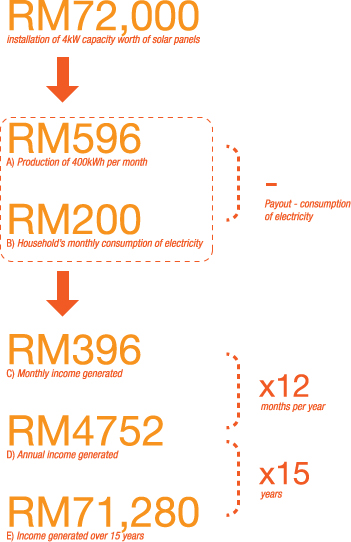
Breaking down the numbers: How your 4kW system will pay for itself in around 15 years.

A normal household would usually need about 4kW capacity worth of solar panels, which would cost around RM72,000 to install. That’s about the price of a brand new Toyota Vios.

Too expensive to go green? Think again. Your Toyota Vios’s commercial value will be depreciating at a rate of about 10% a year, but not the income that you would be receiving from installing solar panels on your roof.

Under the FIT system, TNB will sign a 21-year agreement with households and pay at least RM1.49 per kWh electricity generated. Assuming production of 400kWh per month, this would amount to a payout of RM596 per month.

If a household’s electricity bill is RM200 a month, there would still be a steady monthly income of RM396 for the next 21 years, which could be used to repay the loan taken to install the solar panels. The 4kW system would pay for itself and start turning a profit within 15 years.

It is also worth highlighting that one will get paid more under the FIT mechanism if locally-manufactured or assembly solar inverters or photovoltaic modules are used, and/or used as part of building materials.

Granted, the scheme doesn’t bring about huge profits all at once, but I think most middle-class families would now be able to afford to install solar panels should they wish to.

However, it should also be noted that there will be an annual degression rate of 8% for the solar photovoltaic system. In other words, the later one joins the FIT scheme, the lower the FIT rate one will receive. This is based on the assumption that the cost of solar panels would go down once more people adopt it.

The degression rate will be reviewed every three years by the soon-to-be-established Sustainable Energy Development Authority to ensure the rates remain reasonable.

Making renewable energy commercially-viable

Residential homes aside, commercial renewable energy producers are the ones who are set to benefit the most from the FIT mechanism and who seem most excited about the new scheme.

Prior to the Act, TNB paid the same rate of RM0.21per kWh for energy whether or not it was produced from environmentally-friendly resources or from fossil fuel.

Under the FIT scheme, biogas and biomass electricity producers will finally be rewarded for their pioneering efforts and get paid at least 28% more than fossil fuel producers, as shown in the table below.

Biogas Basic FIT rate (RM) Biomass Basic FIT rate (RM)
Up to 4MW 0.32 Up to 10MW 0.31
Up to 10MW 0.30 Up to 20MW 0.29
Up to 30MW 0.28 Up to 30MW 0.27

Source: Renewable Energy Bill

They will be signing a 16-year contract with TNB and enjoy the same competitive rates throughout the period.

In addition, those who use locally-manufactured or assembled gas engine or gastification technology will enjoy a bonus of one sen on top of their basic FIT rate.

Biogas electricity producers who use landfill or sewage gas as a fuel source will further enjoy a bonus of eight sen. Biomass players will enjoy an additional 10 sen for using municipal solid waste as their fuel source.

Already, a 26ha renewable energy park is being built on a remediated landfill in Pajam, Nilai, which would consist of a 2MW biogas plant and 8MW solar power facility, and is expected to generate RM12mil gross national income in 2020.

Meanwhile, small hydro producers enjoy less incentive at RM0.23 to RM0.24 per kWh but their contract with TNB will last for 21 years under the FIT mechanism.

Renewable Energy Fund

The government or TNB will not be forking out its own money to pay the higher FIT rates. The funds will come from consumers. There will be a one percent hike in the current electricity tariff, expected in 2012, the revenue of which will be used to finance the Renewable Energy Fund needed to finance the FIT scheme.

In other words, if your electricity bill is RM200, you will be paying an additional RM2 and that amount will go into the Renewable Energy Fund.

However, the FIT mechanism is not meant to last forever.

It is expected that the cost of producing renewable energy will eventually be cheaper than electricity currently produced by fossil fuel producers. This is also given the fact that current energy prices do not reflect the true cost of production due to subsidies for natural gas and the government-controlled electricity tariff.  Once the cost of renewable energy drops below fossil fuel energy, the Renewable Energy Fund will cease to exist.

At that point, TNB would be able to directly purchase power from renewable energy producers as it would be cheaper than electricity produced from fossil fuel like gas and coal.

(© Indymedia | Wiki Commons)

In the meantime, for the FIT mechanism to be implemented successfully, the government will need to widely publicise the new scheme to home owners and commercial producers and for many to participate in it. Only then will Malaysia be able to increase its renewable energy production to meet and hopefully, surpass its target of 11% by 2020. If Malaysia can push its renewable energy industries forward and make them cost-effective, not only would we be reducing our reliance on fossil fuel and carbon emission, we could even drop the idea of going nuclear, too.


Gan Pei Ling is looking forward to installing solar panels in her own home.

Greater transparency with Selangor’s sunshine law

by Gan Pei Ling / 15 April 2011 © Selangor Times

Selangor made history when it became the first state in Malaysia to pass the Freedom of Information (FOI) Enactment at its state assembly on April 1.

The state now joins more than 90 countries, including our neighbours Thailand and Indonesia, with an FOI law that recognises citizens’ right to information.

The Centre for Independent Journalism (CIJ) has hailed the passing of this law as a “breakthrough” amid an entrenched culture of secrecy among our government bodies backed by the Official Secrets Act (OSA).

Compared to its original draft tabled last July that was heavily criticised by civil societies, the FOI Enactment passed last Friday has seen several improvements.

Greater transparency and accountability

Firstly, civil servants can now be fined up to RM50,000 or sentenced to five years’ jail, or both, if they are convicted of intentionally giving false or misleading information.

It is also considered an offence if civil servants intentionally restrict or deny public access to information, unless that information is specifically exempted under the law. Civil servants were not liable to such a penalty in the original draft of the FOI Bill.

Secondly, the FOI Enactment now covers not only state departments, but local councils and all state-owned or state-controlled bodies as well.

Thirdly, the Appeals Board has been replaced by a more independent State Information Board to review appeals from applicants whose requests for information have been rejected.

Under the law, the State Information Board must be led by former legal practitioners and independent members not holding any political office or position in any political party.

CIJ also pointed out other improvements in the law, such as a narrower list of exemptions and a 20-year time limit for keeping exempted information confidential.

In addition, information officers and civil servants who disclose information in good faith are protected from prosecution, sanctions and suits.

Impact on general public

When asked by Selangor Times how the FOI Enactment would benefit the people, CIJ executive officer Masjaliza Hamzah said the law had far-reaching impacts in very practical ways.

“If there’s a landslide and the state sets up a committee to inquire into it, under the FOI Enactment, one could argue that the public should have access to reports about the proceedings, including statements recorded from those who testify.

“In other words, we don’t have to wait for the Menteri Besar to declassify it,” said Masjaliza.

“If the playground near your house is in a bad state, you can ask the local council for the amount spent on maintenance and find out who built it.

“Of course, all these are just scenarios; the law will need to be tested,” she said.

FOI select committee chairperson Saari Sungib (Hulu Kelang) had told Selangor Times previously that the state expects tremendous requests for information at local councils and land offices once the law is enforced.

One can anticipate concerned residents requesting information on the state and local councils’ expenditure, tenders awarded and land transactions, to name just a few.

Despite that, it should be noted that filing an application and pursuing it would still take time and energy.

Limitations of the FOI Enactment

Nevertheless, Selangor’s FOI Enactment has certain limitations.

Information classified as official secrets under the OSA is beyond the state law’s jurisdiction.

Individuals’ private information or trade secrets obtained by the state in confidence, as well as information that would “severely jeopardise” the state’s policy implementation or development, can also be kept confidential.

However, such information can be disclosed if there is an overriding public interest or if it is for the investigation of an offence or misconduct.

Besides that, a good FOI law should keep the application fees low, but this was not stated in the enactment.

“Costs should be kept low. Otherwise, it can become an administrative obstacle that denies the public affordable access to information,” CIJ pointed out in its April 1 statement.

CIJ also highlighted that the enactment did not specify the appointment process of the State Information Board.

“This must be an open and transparent process where the public can nominate candidates and the shortlist is published. This will strengthen the independence of the board,” CIJ added.

The law also does not mandate the periodic publication of information to make information more accessible to the public.

“Routine publication will help to reduce the administrative burden on information officers and increase transparency across all public bodies,” said CIJ in response to the shortcomings in the law.

The state’s FOI taskforce chief, Elizabeth Wong, said the FOI Enactment is a “dynamic, living legislation” and the legislature can improve the enactment from time to time.

“This is only the beginning of our journey to introduce a culture of openness and transparency in public administration,” said Wong.

Related post: Freedom of Information FAQ

Freedom of Information FAQ

Compiled by Gan Pei Ling / 15 April 2011 © Selangor Times

What is Freedom of Information (FOI) and why do we need laws to ensure it?

As tax- and ratepayers, the public has a right to know how governments use and manage public funds. FOI laws empower the public with access to information, and allow inspection of files and scrutiny of government administration.

In other words, a good FOI law helps promote transparency, accountability and reduce graft.

Does Malaysia has a FOI law?

We do not have a FOI law at the national level, but Selangor passed the FOI Enactment in its state assembly on April 1. It is the first state to do so.

Following Selangor’s footsteps, Penang also tabled its FOI bill in November 2010, but the draft has came under fire from civil societies as lacking in substance.

The Selangor FOI bill also came under severe criticism when it was first tabled in July 2010. However, the legislature appointed a select committee to consult civil societies and civil servants to improve the bill.

An amended version was tabled on March 28 and passed without objection on April 1.

When will Selangor’s FOI Enactment come into force?

Elizabeth Wong, who is leading the Selangor’s FOI taskforce, said it would take around six months for the state to enforce the law.

She said they would need to appoint and train information officers in all relevant bodies to handle information applications, draft the application forms, and set up a fee structure.

Selangor also needs to set up the State Information Board, which would review appeals from applicants whose request for information has been rejected.

Wong, who is also the executive councillor on tourism, consumer affairs and environment, estimated that Selangor would need to allocate RM1 million to enforce the FOI law.

Who will give me information? Is there a fee?

An information officer will be trained and appointed in each department to handle public requests for information. The information officer is required to respond in writing to your application within 30 days from the date of acknowledgement of the application.

Illiterate or people with disabilities may make a verbal request to the information officer, who will then make a written application on behalf of the applicant and provide a copy of it to the applicant.

The fee structure has yet to be ironed out by the state.

What is covered under Selangor’s FOI Enactment?

Once the FOI law comes into force, you can request for information from any state department, local council, or any entity owned or fully controlled by the Selangor government. For example, you can request for information on the state and local councils’ expenditure, tenders awarded, and land transactions.

However, information classified under the federal Official Secrets Act, individuals’ private information, and trade secrets obtained by the state in confidence are exempted under the FOI enactment.

Secrets from states or international organisations may also be kept confidential if its disclosure would affect Selangor’s relations with other states or international organisations.

The information officer may also refuse to disclose information that is likely to severely affect Selangor’s development.

Despite that, information must be provided if there is an overriding public interest that outweighs the risks stated above.

The information officer may also allow access to exempted information if it is required for the investigation of an offence or misconduct.

However, all exemptions lapse after 20 years.

What if my application is rejected, or if I’m not satisfied with the information provided?

You can appeal to the State Information Board, made up of former legal practitioners and independent members, within 21 days after you receive the notice from the information officer.

Sources:
FOI Enactment (Selangor)
www.cijmalaysia.org
www.righttoinformation.org

Related post: Greater transparency with Selangor sunshine law