Remembering Teoh Beng Hock

by Gan Pei Ling / 7 Sept 2012 © Selangor Times

Mysterious fall. Open verdict. Suicide. It’s been three years since political aide Teoh Beng Hock was found dead at the Malaysian Anti-Corruption Commission (MACC)’s office in Shah Alam but the cause of his death remains contentious till today.

On Sept 22, a documentary based on the tragedy, titled “Rights of the Dead”, will be shown for the first time during the Freedom Arts Fest at the Petaling Jaya Live Arts Theater at Jaya One.

The 25-minute film is directed by Tricia Yeoh, who obtained a RM6,000 grant from Pusat Komas in May to make it.

She raised another RM6,000 from public donations to complete the film.

Yeoh, a well-known newspaper columnist and policy researcher, was working as a research officer for the Selangor Menteri Besar when the tragic incident occurred.

She subsequently became the state government’s liaison officer for the long-drawn case.

The 30-year-old has since left the Selangor government in April 2011 to join a private marketing research firm as its director of business development.

She shared with Selangor Times in an interview on Aug 27 why she decided to take time off from her job to make the documentary, the challenges she faced as a first-time filmmaker and what viewers can expect from the film.

Why did you decide to make a film about Teoh Beng Hock?

Yeoh interviewing Beng Hock’s father Teoh Leong Hwee, 59, and mother Teng Shuw Hoi, 59, at their home.

I think it was important to record what happened. He died when I was still an officer in the Menteri Besar’s office. I was kind of like the liaison officer for the case, representing the Selangor government. I dealt with the lawyers, [state-appointed forensic pathologist] Dr Porntip [Rojanasunan] from Thailand, the family…and I always felt there was no real conclusion to the case.

It’s been three years since he passed away, his death still affects the family and friends. But you know the general public has short memories, they eventually forget. I wanted to capture some of the moments in time, to have something for people to watch, maybe for his own son to watch when he is older.

When I left the Selangor government, this was one of the things that was still unresolved. This is also my own way of coming to a resolution, dealing with the emotions that I was going through when I was working on the case.

I applied for the grant from Komas last year but I didn’t get it so I applied again this year. It’s been something that has been on my mind for a long time.

Did you know Teoh Beng Hock personally?

I only knew him in passing. I’ve seen him at press conferences, at the lift (at the state secretariat). We would say “hi” to each other but we never really spoke. So even his boss [Selangor executive councillor] Ean Yong [Hian Wah] was quite surprised that I had taken such a big interest in the case.

I think I was very affected by it because I thought it could have happened to me, as one of the officers [working for the Selangor government]. I felt very bad for the family members who were forced to be thrust into the public sphere as a result of what happened.

Is this your first film?

Yes, I’ve never done anything related like this before. It was quite stressful. I didn’t know anything about filmmaking. Compared to writing about policies, there’s a lot of creative processes involved in making a documentary.

Pusat Komas gave me guidance on what roughly needs to be done but I still needed to seek my own help and advice. On the technical part, I had to completely rely on my cameraman and sound person. I didn’t know the names of the equipment, for example the difference between a mixer and a recorder but now I do. (Laughs) I had a video editor as well, and someone to do the graphics, audio tracks. (Local artist) Jerome Kugan wrote a song for the film.

I had a really good team of people and I’m really thankful.

What’s the angle of the film?

Teoh Er Jia, now three, never knew his father.

Originally I wanted to make the film from the son’s point of view, but we realised that would be very difficult. Who becomes the voice? If he was older maybe I could get him to talk but he’s too young now. (Teoh Er Jia, now three years old, was born after Beng Hock’s death. His fiancé Soh Cher Wei, 31, was already pregnant when the tragedy occurred.)

So eventually I decided to tell the story from the point of view of someone who was there, who was working behind the scene to find out what happened. It’s a personal journey of investigation and exploring, so the viewers will have a glimpse into my thought processes.

We explored the institutions that were involved, the MACC, the police, the forensics behind it and the judiciary. I looked at these four institutions and how they may have been compromised in order to come to a certain conclusion. I talk about the political context but I’m looking more at the flaws of the institutions, that we’re subjected to weaknesses in the system because these institutions are not independent.

I also look at the personal perspectives of the family as well. But I do want to drive home the point that it’s because of this flawed system we have that somebody died. We’re all part of the system. We as Malaysians, it could have been anyone of us. If you don’t have a fair and independent judicial system, who can you rely on at times of trouble?

Did you manage to interview representatives from these institutions for your film?

I got to speak to the MACC. I actually requested an interview with everyone, the police, the Attorney-General’s Chambers, the MACC lawyers, the Royal Commission of Inquiry (RCI) into Beng Hock’s death…I contacted everybody but only MACC agreed to an interview. I was pleasantly surprised and I’m quite glad that I got them.

I had also tried to speak to the head of the RCI, Tan Sri James Foong, but he declined to give an interview and said everything [to be said] is already in the report. That’s a fair statement. It’s his prerogative. The rest didn’t respond to my [interview requests].

Apart from the difficulty of getting hold of the authorities, can you share other challenges you faced in making the documentary?

One of the challenges was that there was just so much information but I couldn’t put everything in. That’s the process in filmmaking but as a researcher I found it quite frustrating and sad that I had to leave out several things that I felt were important because of the time limit.

If I have more funds in the future I might do a longer version, a different cut, maybe an hour long. I already have the footage, I have so much material.

The other challenge was to find a fresh perspective because this is a case that everybody has read or knows about. I want to bring something new, different to the table, so I tried to do this by putting in things people may not have known or have forgotten. For example, there was an SMS (Short Message Service) sent by a MACC officer to her senior, telling the senior to tell other officers don’t lie anymore, this is a big case. This came out in the RCI. If you’re asking people not to lie, the implication is that people have been lying.

What were some of the important details that you had to leave out?

Dr Porntip, a well-known forensic pathologist from Thailand, claimed she was pressured against testifying at the inquest. She had maintained that Beng Hock did not commit suicide.

There were a lot of questions raised on the evidence found on his body, I couldn’t focus on every single thing, for example the drag marks on the shoes. And the fact that he didn’t have a defensive wound on his wrists. Usually if you fall from height, the person will suffer a colles’ fracture because it’s a natural reaction from the body to break the fall, even if it’s a case of suicide. But in this case, there wasn’t any fracture so it raises the question of whether he was conscious when he fell. There was an anal injury as well, which Dr Porntip said was unusual for any fall from height. These are some of the details that don’t gel with the fact that he committed suicide that I couldn’t look at in the film.

And then there was the window that he was said to have fallen out. It was not tested for DNA and the reason the police gave during the inquest was that they had done fingerprint dusting first, but because the window surface too dusty, they couldn’t get any fingerprints out of it either. When we asked Dr Porntip what’s the first thing you would do when you look at this crime scene, she said the first thing is actually to look for DNA.

You really have to decide what are the best things to put in the film. I had to leave them out because there was no time. It’s a huge case.

And you interviewed the family as well for the film?

Yes. The wife, the sister and the parents.

How are they?

I don’t talk about how their life is now in the film but I think the sister is still very much affected. She’s the one who’s the most emotional about it still. I think it’s very hard for her to move on because she was the closest to him…The parents are still hurt, the mom thinks they’re still waiting for something to happen, some answers.

They’re still hoping for some answers?

I’m not sure “hope” is the right word to use. They’re quite burned out. I think all of them are very cynical (by now) about whether there can be any answer (to the cause of his death). What else can they do to get answers? They want explanations. Obviously they can’t accept that it was a suicide. They want answers but they can’t expect it realistically, so they’re left in this conundrum.

I’m not just talking about their family. Other people have died in custody as well. My documentary didn’t talk about the other victims but I want people to think about them also. This is just one case, one story, there are countless families whose children have also died in custody, and because of what? It’s because the system is too highly politicised and there’s no independence.

It’s ridiculous when you think about it. Innocent families are suffering because of the way our institutions are being run. (Lapse of silence)

You speak to the colleagues as well?

I spoke to his colleagues at the state (secretariat) and former colleagues at Sin Chew Daily, the lawyers, I also went to Bangkok to interview Dr Porntip.

Are they still affected? 

I think when you talk to them, you can still sense that they are angry. It’s not just anger but dejection, a sort of dejected anger. Even for me, if you were to ask me am I angry? Yes I am, but it’s a sort of tired anger. It’s very emotionally-draining for anyone who has followed the case through.

When it happened, when you were following the case, you would feel emotionally or psychologically affected by it. It’s quite haunting. Even during the research for the documentary, you get drawn in and you remember what happened in the past.

I mean, of course everybody has to move on, the lawyers have to take on new cases, people have lives to lead, but when you think back, maybe we can move on but the family will never do.

Do you think your documentary serves as some sort of closure for the case?

I don’t know whether it serves as a closure. I’m not seeking to give you answers in the documentary. I don’t want to say who was at fault, who was in the wrong politically but I do want people to realise for themselves what’s the real issue here.

I want the film to serve as a reminder that this case is part of a bigger problem. People who are not politically-conscious yet should realise that it’s because of politics, our system of governance, that this sort of tragedy has happened.

The film trailer is available on Facebook at http://bit.ly/TBHdocu. Freedom Arts Fest, formerly known as Freedom Film Fest, is an annual event organised by Pusat Komas. This year’s theme is “Democracy: Who’s the Boss?” and Yeoh is one of three local filmmakers who won a grant to make a documentary based on the theme.

Find out more about other human rights films and the screening schedule at freedomfilmfest.komas.org.

Solving Selangor’s water woes

by Gan Pei Ling / 20 August 2012 © The Nut Graph

Syabas logo (source: syabas.com.my)

Syabas logo (source: syabas.com.my)

SELANGOR, apparently, is facing a water crisis. On 15 July 2012, Selangor’s sole water distributor Syarikat Bekalan Air Selangor (Syabas) announced its application to carry out water rationing exercises in Selangor, Kuala Lumpur and Putrajaya.

The Selangor government responded with puzzlement. Representatives said the state’s seven dams were filled to the brim. But Syabas countered that regardless of the dams’ water levels, Selangor’s 34 water treatment plants are operating at full — and some over-capacity. It said overall water reserve levels were down to two percent instead of the “safe mark” of at least 20.

After the Selangor government proposed to take-over Syabas and a Special Cabinet Committee on the Selangor Water Issue refused Syabas’s proposal, Syabas backed down. Water rationing was a “long-term plan” but it wasn’t necessary to implement it now, said its chief operating officer Datuk Lee Miang Koi.

So were the 7.5 million consumers in Selangor, Kuala Lumpur and Putrajaya taken for a ride? Is there or is there not a water crisis and what is being done to ensure it doesn’t happen?

Water crisis?

There is currently no widespread water shortage across the state and two neighbouring federal territories, according to a Selangor government task force set up to monitor Syabas’s daily operations.

Khusrin Munawi (pic source: jais.gov.my)

The task force led by state secretary Datuk Khusrin Munawi and staffed with water experts and Selangor Economic Planning Unit (UPEN) officers also uncovered something revealing. Selangor’s 34 treatment plants are jointly capable of treating up to 4,807 million litres of water per day (MLD). But, Syabas is only capable of distributing up to 4,411 MLD. So even if the treatment plants fulfilled their full potential in their water treatment capacity, Syabas still can’t distribute all of it. Moreover, an ongoing mitigation project will reportedly boost the treatment plants’ capacity to 5,139 MLD in March 2013.

In addition, up to 1,389 MLD is lost due to pipe leakages and theft, also known as non-revenue water. Only some 2,944 MLD treated water reaches consumers. A 32% of non-revenue water is extremely high compared to five percent in Singapore and seven percent in Germany.

Syabas has said that the Selangor government needs to approve the Sungai Langat Two treatment plant to alleviate the water crisis. The multi-billion project involves transferring and treating raw water from Pahang. Federal government ministers also support the project.

But why push for a mega project when Syabas can’t even distribute all the water it treats? And why doesn’t Syabas fix the pipe leakages and theft before advocating a multi-billion ringgit interstate water transfer project?

Non-revenue water

Syabas says the Selangor government is to blame for freezing its capital expenditure programme and thereby jeopardising efforts to bring down non-revenue water. But federal lawmaker Tony Pua pointed out in a 7 August public forum that the state has no obligation to fund the private company.

Tony Pua (file pic)

Tony Pua (file pic)

“The [concession] agreement says Syabas may request for funding from the state. But [there are] no obligations on the part of the state to fund Syabas’s pipe-replacement programmes,” said the Petaling Jaya Utara Member of Parliament in an email to The Nut Graph on 17 Aug 2012.

The Selangor government has taken issue with Syabas’s financial management. It sought to terminate the concession agreement with Syabas in 2008 as an audit report found the company had breached contract terms. This included awarding up to 72% of contracts, worth RM600 million, in direct negotiations instead of via open tenders as stipulated in the 2004 concession agreement.

Old spat

The recent water spat is but an extension of the three-year deadlock over the state’s water restructuring exercise.

Khalid Ibrahim (file pic)

Khalid (file pic)

Menteri Besar Tan Sri Khalid Ibrahim’s administration has been trying to restructure the fragmented water industry and terminate what it claims are lopsided concession agreements with the existing water concessionaires.

Three companies — Puncak Niaga Sdn Bhd (PNSB), Konsortium Abass Sdn Bhd (Abass) and Syarikat Pengeluar Air Sdn Bhd (Splash) treat the raw water from dams. Syabas distributes it to consumers. The Selangor government says it can improve efficiency and keep water tariffs low if it restructures the water sector by taking over the four companies. It offered RM5.7 billion for them in February 2009 and revised it upwards to RM9.3 billion in June 2009 after the initial bid was rejected.

Splash, a Gamuda subsidiary, and Selangor-owned Abbas accepted the RM9.3 billion deal. But, Syabas and PNSB, both owned by Puncak Niaga Holdings Bhd, snubbed the offer. Puncak Niaga Holdings executive chairperson Tan Sri Rozali Ismail was formerly an Umno Selangor treasurer.

It cannot be proven that partisan interest came into play but the refusal of the deal is certainly in line with how the federal government has dealt with Selangor’s water-restructuring efforts. It has repeatedly ignored Selangor’s requests to terminate the concession agreement with Syabas. As the agreement is signed between Syabas, the Selangor government and the federal government, Selangor can’t terminate the agreement without the federal government’s agreement. The federal government also refused public disclosure of the concession agreement, which is classified under the Official Secrets Act. It has also not exercised its power under the Water Services Industry Act 2006 to intervene and resolve the impasse. Under the Act, the federal government may assume control of the concessionaire’s business if it is deemed necessary for “national interest”.

One has to ask whether the federal government is acting in good faith when it was previously supportive of Selangor’s investment arm Kumpulan Darul Ehsan Bhd’s plan to consolidate the fragmented water sector. This, however, was before the 2008 elections when Barisan Nasional was still in power in Selangor.

Consumers first, politics later

(Jenn Durfey | Flickr)

Water is a vital need for all. It is unfortunate that it seems to have become a part of politicians’ arsenal in trying to win the public’s favour. The recent “water crisis” claim highlights again how urgent it is to end this three-way deadlock between the Selangor government, Syabas and the federal government.

Khalid’s administration proposed to hire an international arbitrator back in 2010 to ensure the four companies received a fair offer from the state. At the very least, parties could agree to this to see whether an acceptable and face-saving solution can be found to ensure that Selangor residents’ water supply is not jeopardised.

From dumpsites to nature sanctuaries

by Gan Pei Ling / 16 July 2012 © The Nut Graph

THINK of a landfill. What comes to mind? First thing – probably the stink. Toxic leachate seeping out and contaminating waterways. Now, imagine a landfill so clean that people have picnics and take nature walks there. Impossible? Think again.

On a recent visit to Singapore after covering an international conference for National Geographic‘s energy blog, I visited the Republic’s only landfill. Located 30km from the  mainland, the Semakau landfill began in 1999 and has become a nature haven for bird-watchers, anglers and marine biologists, as well as astronomers.

“The environment is so clean that nature is able to survive and thrive [here],” senior manager Ivan Yap proudly told visitors during a tour on 4 July 2012. Indeed, 66 bird species and 17 fish species have been found in and around the landfill. Visitors can also marvel at exposed mangroves, coral reefs and starfish along the coastline during low tide.

As the island is free from light pollution, the Astronomical Society of Singapore carries out stargazing activities on it.

How did Singapore manage this? And what lessons can Malaysians learn from our neighbour to improve our waste-management system?

The landfill off the coast of Singapore

An engineering marvel

Due to land scarcity, Singapore closed its last landfill on the mainland in 1999 and spent S$610 million (approximately RM1.5 billion) to construct the Semakau landfill in the ocean.

The offshore landfill is made up of the Semakau Island, Sakeng Island and a 7km rock bund that encloses a part of the sea off the two islands. According to Yap, the rock bund is lined with impermeable membrane and marine clay, a material commonly found in the sea bed, to prevent any leachate from contaminating the sea. Monthly checks are done to ensure there is no leakage, he said.

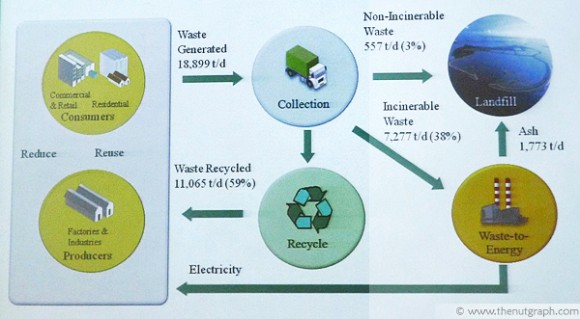
Singapore has four incinerator plants and burns almost all its trash to reduce the volume of waste by at least 90%. It then ships the ash and non-incinerable waste, such as construction debris and treated sludge from factories, to the 350-hectare landfill.

“We don’t receive organic waste, that’s why the landfill doesn’t stink,” Yap explained.

The waste management system in Singapore at a glance

Nevertheless, the landfill’s general manager, Ong Chong Peng, said there are four dry cells and a small leachate treatment plant in case they have to receive food waste.

The landfill has received over 10 million tonnes of ash and waste since 1999 and is expected to last at least another 33 years.

Ong said the recycling rate in Singapore is around 59% and the country aims to shore it up to 65% by 2020 and 70% by 2030 to prolong the life of their only landfill.

Separate, burn then bury

Malaysia has been slow to adopt incinerators, with most of our states still relying entirely on landfills to bury our trash. Not all of our dumpsites are equipped with proper facilities to treat landfill gas and leachate.

We also don’t segregate our household waste. Our recycling rate is dismally low at about 11%. The federal government aims to increase this to only 40% by 2020. Paradoxically, it also aims to become an advanced nation capable of managing our resources efficiently by 2020. This would hardly be the case if we’re still wasting valuable resources and precious landfill space by dumping more than half of our recyclable items into landfills.

Our political leaders need to snap to their senses. We don’t have an infinite amount of land to bury our household waste, which is increasing at an annual rate of around two percent. The people in Selangor and Kuala Lumpur throw out an average of 7,375 tonnes of garbage – the equivalent of about 1,400 Borneo pygmy elephants – a day.

The federal government’s move to provide separate bins for organic waste is a good start.

The waste reception hall at Semakau landfill

We should be aggressively emulating not just Singapore but cities like Malmo in Sweden, which use their food waste to produce biogas to power the buses in their city.

Malmo also recycles close to 98% of its household waste. Their municipal waste company provides separate, clearly labelled bins for not just glass, paper, cardboard, metal and plastic, but for batteries as well.

If anything, Singapore and Malmo have demonstrated that it is possible to manage waste more creatively. Stinky, polluting landfills need not be the norm. Malaysia already has an increasingly eco-conscious populace, all we need now is political will.


Gan Pei Ling believes Malaysia is capable of outdoing Singapore and Sweden to become a more sustainable nation.

Slow death by aluminium smelters?

by Gan Pei Ling / 18 June 2012 © The Nut Graph

WHILE green activists in Peninsular Malaysia are protesting the rare earth refinery that has yet to begin operations in Gebeng, Pahang, villagers living near an aluminium smelting plant in Balingian, Mukah, Sarawak, have been suffering in silence.

Documentary filmmaker and former TV2 producer Chou Z Nam has highlighted the Iban villagers’ plight in four short videos, all available on YouTube, and a report after a field visit in February 2012. Chou is well-known for his documentaries on the Bakun Dam and its impact on local communities. His Bakun Dam documentaries were axed by RTM and he was sacked after disclosing the self-censorship.

How is the aluminium smelting plant affecting the lives of local communities in Balingian? Should we be alarmed at plans for new plants?

The aluminium smelting plant in Mukah (Source: unireka.com)

Declining health and dying crops

In Chou’s first short video released on 22 March 2012, villager Sandy Dancan, 18, complained of skin irritation and rashes which she has had since 2010. Dancan lives 300m away from the plant owned by Press Metal Sarawak Sdn Bhd.

Another villager, Cynthia Unau, 25, worked as a cleaner at the smelter for six months in 2011. She claimed she fell sick while working there in Chou’s second video released on 24 March 2012.

A simple health survey conducted by Chou and local activist Matek Geram found that villagers from three longhouses located 300m to 2.5km from the factory reported symptoms of breathing difficulties, coughing and dizziness, among others. The affected families say they spend RM150 up to RM500 a month for medical treatment.

It was also observed that plants growing 50m to 200m from the factory including nipah, coconut, sago, banana, oil palm and ferns, were dying.

Farmers living within 12km of the smelter have claimed loss of livelihood as their crops cannot bear fruit, while fisherfolk at Batang Balingian alleged that their catch has dwindled, possibly due to acid rain pollution.

Chou’s documentary also records an unidentified former employee accusing the smelter of only using one out of its three compressors to treat air pollutants including hydrogen fluorideand sulphur dioxide in order to save energy costs. The informant claimed that although the plant was equipped with the required pollution control facility, it wasn’t fully utilised when he was working there.

Press Metal Sarawak refuted these claims in a Borneo Post report published on 8 May 2012. Its human resources general manager, Soh Siew Ong, said the smelter only released clean gas into the air and that no water is discharged from the plant.

A screenshot of Cynthia Unau’s testimony featured in Chou’s video

More smelters in the pipeline

While villagers in Balingian are still grappling with the health impact of living near an aluminium plant, at least two new larger smelters are expected to be built in Bintulu.

Press Metal Bhd secured a RM350 million loan in May 2012 from two local banks to finance the construction of its second aluminium smelting plant in Bintulu’s Samalaju Industrial Park. The plant is expected to produce 240,000 tonnes of aluminium annually, double the capacity of the existing Balingian plant.

Smelter Asia, a joint venture between Gulf International Investment Group Holdings Sdn Bhd and Aluminium Corp of China, also plans to build a smelter in the same industrial park, with an even larger annual capacity of 370,000 tonnes.

Aluminium smelting involves a chemical process to extract pure aluminium from its oxide called alumina. But the process leaves behind fluoride pollutants, including the pungent and toxic hydrogen fluoride as well as perfluorocarbons (PFCs), which are far more potent greenhouse gases than carbon dioxide.

In addition, an aluminium smelting plant is an energy guzzler as a high temperature of 970 Celsius is needed to melt the alumina. For example, while the Mukah district consumes two megawatts of electricity per month, the Balingian smelter alone uses up to 200 megawatts a month, according to Press Metal Sarawak. Smelter Asia is also in talks with Sarawak Energy Bhd to secure over 600 megawatts of power supply.

Heed the warning signs

The process of extracting aluminium is an environmental challenge. Yet, aluminium is highly sought after to make vehicles and for food packaging, and is arguably a necessity in modern life. The aluminium industry is one of the primary forces behind the Brazilian government’s plan to dam rivers in the Amazon to meet the industry’s high energy demand. Sarawak seems to be going down the same path with its grand plan to build 12 mega dams despite growing local opposition.

Unlike the case with Lynas, a detailed environmental impact assessment was done for theBalingian smelter. But given the current complaints, the government authorities need to be more proactive in addressing villagers’ complaints on health problems, pollution and dying plants. These are merely warning signs of a potentially larger underlying problem. If, as Press Metal Sarawak claims, no air pollutants have been released by its smelting plant, then what is the real source of pollution in Balingian? Shouldn’t the authorities be investigating?

Taib Mahmud (Wiki commons)

As Chou recommended in his fact-finding report, a more thorough health study needs to be conducted to ascertain the cause of the villagers’ sicknesses. Rainwater and plant samples ought to be collected by the state Department of Environment to find out if they are contaminated with pollutants from the smelter.

The Balingian smelter is located Sarawak Chief Minister Tan Sri Abdul Taib Mahmud’s constituency. Surely he wouldn’t want an environmental and public health scandal in his own backyard.

In addition, the Sarawak government ought to rethink its development strategy. Building more smelters may indeed spur the state’s economic growth, but not at the expense of the health and quality of life of the locals, unless the companies are held to strict environmental standards.


Gan Pei Ling thinks more public attention needs to be given to the health and environmental impact of aluminium smelting plants in Sarawak. They certainly deserve equal, if not more, public scrutiny than Lynas.

What will remove opposition to Lynas?

by Gan Pei Ling / 21 May 2012 © The Nut Graph

CONTROVERSY surrounding the rare earth refinery in Gebeng, Pahang has generated lively, and sometimes polarising, debate among those who support and those who oppose Lynas Corp. The debates have, among others, centred on the refinery’s impact on the environment and local communities, and the government’s role in the matter.

In August 2011, local experts from the Academy of Sciences Malaysia (ASM) and the National Professors’ Council also weighed in by producing a report on rare earth industries. The report acknowledged that the industry presents both economic opportunities and environmental and health risks to local communities. The academy invited four foreign experts to visit the Gebeng plant, and asked them to give their views in a 9 May 2012 public forum.

Panel of experts at the 9 May 2012 forum organised by ASM

What do the Academy of Sciences and the four experts think about the rare earth refinery in the east coast of Peninsula Malaysia? And what will it take to remove opposition to a project that brings economic benefits just as it stokes fears for public safety and health?

Evaluating the refinery

Neill

After their 8 May 2012 visit, all four experts, from Canada, the US, China and Germany, agreed that the Lynas Advanced Materials Plant (LAMP) was well designed. Alastair Neill, a trained engineer and executive vice-president of Dacha Strategic Metals, described the refinery as a “world-class facility”. The Canadian, who has been in the industry since 1995, thinks the Gebeng refinery is the best among the plants he has seen in China and Japan.

Neill noted that Lynas would attract a lot of downstream companies to Malaysia as demand for rare earth elements in the green technology sector was fast rising. To illustrate, he said rare earth metals are commonly used to manufacture the more energy-efficient compact fluorescent light bulbs. He noted that China produced 62 million compact fluorescent light bulbs in 2008 and the production doubled a year later.

In addition, Neill highlighted that a hybrid or electric car uses around 10kg to 12kg of rare earth metals while wind turbines of one-megawatt capacity, made of neodymium magnets, use about 400kg.

Lifton

Founding principal of Technology Metals Research, Jack Lifton, remarked that Lynas is Malaysia’s “gateway to 21st century technology”. The American expert has been involved in the rare earth industry for 48 years and thinks the pollution risks posed by the chemical plant are “low” and manageable.

Be transparent and proactive

According to the ASM report, the Lynas refinery will generate three types of wastes — Water Leach Purification (WLP) residue, Flue Gas Desulphurisation residue and Neutralisation Underflow (NUF) residue.

Lynas claims it has developed a method to dilute the concentration of radioactive thorium and uranium in its WLP residue from six Becquerel per gram to below one Becquerel per gram, the limit set by the Atomic Energy Licensing Board (AELB). The company is confident it can recycleits diluted WLP residue as road base and NUF residue as fertilisers.

Nonetheless, the International Atomic Energy Agency had, after its visit in June 2011, recommended that the company locate and build a permanent disposal site in the event that Lynas failed to commercialise its waste residue.

Prof Dr Yan Chun-Hua from Peking University said Lynas should make public its dilution method of the WLP residue to sooth public concerns over radiation pollution. “[Consult] the public, never fight (with them). The public is always right. They complain and raise questions because they’re concerned. If you can convince the public, they’ll support your project,” said the chief scientist on rare earth functional materials from China’s Science and Technology Ministry.

Lee

ASM senior fellow Lee Yee Cheong, who moderated the discussion, also conceded that the lack of public consultation prior to the project’s approval had fuelled deep distrust between the local communities and the government. He said a detailed environmental impact assessment, instead of a preliminary environmental impact assessment, should have been carried out.

“Going forward, the government must consult the local communities (before approving a project of such scale),” said Lee. He added that ASM recommends that the government commissions a university to carry out a long-term baseline health study to monitor the refinery’s impact on surrounding communities.

Lee said the government should also help clean up the Gebeng industrial zone as some of the existing chemical plants have polluted the environment. “Any development must be green and clean,” he stressed in his concluding remarks at the forum.

Engage and be open

What with the parliamentary select committee and media visits organised by Lynas, Himpunan Hijau and other anti-Lynas groups have clearly succeeded in pressuring the government and the corporation to be more transparent about the refinery’s operations.

Now that the communication channels are open, local communities should continue to ask more questions. These questions could be to find out how Lynas plans to deal with its residues, and whether a permanent disposal facility is needed as different parties seem to have differing views.

For now, the crux of people’s opposition to the refinery lies in fears about the radioactivity of the waste that will be produced. If expert and independent scientists can be convinced that the plant’s operations can be conducted in a way that makes it safe, shouldn’t those who oppose the Lynas plant be open towards different views so long as they are supported by facts and science?

Dr Yan

At the same time, Lynas would do well to regain public confidence by making its processes for dealing with the radioactive waste as accessible as possible to experts and the public. Peking University’s Dr Yan said as much when he was asked to comment on the viability of Lynas recycling its radioactive waste. “I didn’t see the detailed parameters (of the study). But I think Lynas should release the data so the public can [evaluate it].”

By doing so, Lynas would prove that it had nothing to hide. And it would also ensure that any radioactivity will effectively be dealt with through a process that is robust and that has been peer-reviewed. And if the radioactive waste can be dealt with to ensure no public harm, why should there be any more opposition to the rare earth refinery in Gebeng?


Gan Pei Ling is still learning something new about rare earths and sustainable development every other day. She thinks it’s important to keep an open mind when engaging on any issues.

Can’t we trust our mahasiswa?

by Gan Pei Ling / 23 April 2012 © The Nut Graph

IT has been almost six months since the Court of Appeal in a landmark ruling declared it unconstitutional to prohibit university students from supporting or opposing political parties under the Universities and University Colleges Act (UUCA).

Khaled Nordin (source: mohe.gov.my)

On 9 April 2012, Higher Education Minister Datuk Seri Khaled Nordin finally tabled amendments to the UUCA, Private Higher Educational Institutions Act and the Educational Institutions (Discipline) Act for first reading. The three bills were tabled for second and third reading in the Dewan Rakyat on the evening of 19 April 2011 and were passed on the same night after a four-hour debate.

What were the amendments and how would it impact our university students? More importantly, does the revised UUCA provide a freer, safer space for critical thinking and diversity of thought in our varsities?

Few positives

Most notably, Section 15 of the UUCA has been revised to let varsity students join political parties. When the bill was first tabled, however, there was a sub-clause barring students who joined political parties from running in campus elections or holding posts in campus groups. Umno Youth chief and Rembau Member of Parliament (MP) Khairy Jamaluddin, who led the Barisan Nasional Backbenchers Club‘s challenge against the sub-clause, had called it a “ridiculous” restriction.

Although this sub-clause has been removed, I agree with the Bar Council and with Pakatan Rakyat lawmakers that the amendments don’t go far enough. Sections 15(2) to (5) still impede on students’ freedom of expression and association as guaranteed under Article 10(1) of the Federal Constitution.

Students are still forbidden from joining any society or organisation deemed “unsuitable to the interests and well-being of the students or the University” by the university’s Board of Directors under Section 15(2)(b).

In other words, just by a university’s arbitrary decision, students can be banned from joining say, Occupy DataranBersih 3.0 or Himpunan Hijau.

Syahredzan Johan

Bar Council Constitutional Law Committee chairperson Syahredzan Johan notes that this provision restricts the students’ freedom of association. “It’s in fact very patronising. It assumes that ‘the university knows best’,” he said in an e-mail interview.

On top of that, the students cannot express support, sympathy or opposition to any unlawful individual or organisation under Section 15(3)(a) or those deemed “unsuitable” by the Board under Section 15(3)(b).

“Thus, no student can express support or opposition toBersih (as it was declared unlawful) or to take an international example, the Muslim Brotherhood (as it has been outlawed in several countries),” Syahredzan points out.

Section 15(4) also does not encourage students to speak up except on academic topics they’re familiar with.

Given that universities should be providing civil spaces for nurturing critical thought and robust debate, the Bar Council has stated its disappointment with the amendments. It called on the government to scrap these provisions entirely.

Restricting political spaces

Besides that, the UUCA still prohibits students from being involved in political party activities on campus under Section 15(2)(d) in the name of maintaining neutrality on campus.

‘Student Power’ lecture poster (Courtesy of Fahmi Reza)

But how would our universities define “political party activities”? If a student organisation were to invite a politician experienced in labour issues to speak about minimum wage, would this count as a political party activity? Where should the line be drawn?

This clause is not only restrictive but is illogical. Most university students are of voting age and should be allowed to decide for themselves if they want to be involved in political party activities on campus. Why should we be afraid to let university students — who are supposed to be among the best brains of society and our future leaders — organise themselves along national political lines? We expect Malaysians aged 21 and above to vote, yet shut national politics out of university campuses.

There will of course be some students who may blindly support the political party of their choice, but that’s precisely why more space for political debate is needed as part of a holistic education. Students of different political persuasions should be allowed to challenge each other’s ideas within and outside the ivory tower.

In short, it should not be neutrality that we seek for university campuses, but originality and diversity of thought.

After all, as Datuk Hishamudin Yunus, one of the learned Court of Appeal judges in the landmark ruling said: “Universities should be breeding grounds of reformers and thinkers, and not institutions to produce students trained as robots.”

Holistic review still needed

What the amendments have merely achieved is to let varsity students join political parties. The Act still falls short of granting more academic freedom to not just students, but faculty and universities as institutions.

The Higher Education Ministry still maintains a stranglehold over public universities’ management with its power to appoint of vice-chancellors and members of the Board of Directors, when such matters are better left to the academics.

And unlike students in the 1960s, current student bodies do not have financial independence. They are at the mercy of the university administration for funds to organise activities and thus, the type of activities they can hold on campus.

If we truly want to create a vibrant, autonomous academia and nurture young, bold leaders in our universities, a thorough instead of piecemeal review of the UUCA is crucial.